
Prompt engineering is fading. Context engineering is the real work now.
For a while, prompt engineering looked like the commercial unlock for AI. It was visible, easy to talk about and simple to demo.
But the market has moved on faster than the discourse. The companies getting value now are not winning because they found a magic prompt. They are winning because they put the model inside a tightly designed workflow, grounded it in the right business context and constrained it well enough to be trusted.
Context is the real unlock.
The market signal is already pretty clear
IBM found 42% of large enterprises already have AI actively in use, with another 40% still exploring, and 59% of those already involved have accelerated rollout or investment. Microsoft’s 2025 Work Trend Index says 82% of leaders think this is a pivotal year to rethink strategy and operations, while 46% say their organisation is already using agents to automate workstreams or business processes.
That is a useful reality check. Once AI moves from experiment to operating model, the bottleneck stops being “how do we phrase the instruction?” and becomes “what does the system know, what can it touch, and how safely can it complete real work?”
"Some people think it's a case of asking ChatGPT to fix a process, or to start throwing AI agents at problems – but without meaningful context, product rules and safeguards all most business will achieve are more cyber attack vectors and wasted opportunities.”
Darryl Haydn Jones, CTO, Bonbon Group
The expensive mistake is usually not model spend
A lot of teams still obsess over token costs or metrics while quietly burning far more money in senior time, rework and operational risk. IBM’s survey is revealing here: the bigger adoption barriers were skills (33%), data complexity (25%) and integration/scaling difficulty (22%). High price was cited by 21%.
The model bill is often not the thing breaking the business case. A month or two of senior engineering effort spent chasing prompt tweaks instead of fixing retrieval, permissions and workflow state can easily cost £15k–£40k / $20k–$50k in loaded time before you have even counted the cost of bad outputs hitting customers or staff.
That is why prompt work is often overrated commercially. The visible cost is the API invoice. The hidden cost is building the wrong system around it.
Productivity gains show up when AI augments real work
PwC’s 2025 AI Jobs Barometer is harder-hitting than most generic AI hype. It found productivity growth in the most AI-exposed industries rose from 7% to 27% since generative AI took off, with those industries now seeing 3x higher revenue-per-employee growth than the least exposed. It also found AI-skilled roles carried a 56% wage premium in 2024.
That is the commercial clue. If capable people who can work effectively with AI are getting that much more valuable, then the leverage is not in producing prettier model output. It is in raising the output of expensive humans and critical workflows. That only happens when context is good enough for the system to be consistently useful.
This is also why narrow, well-scoped systems tend to beat broad “do anything” assistants in the real world. Businesses do not need theatrical intelligence. They need dependable throughput.
Context engineering is what turns capability into margin
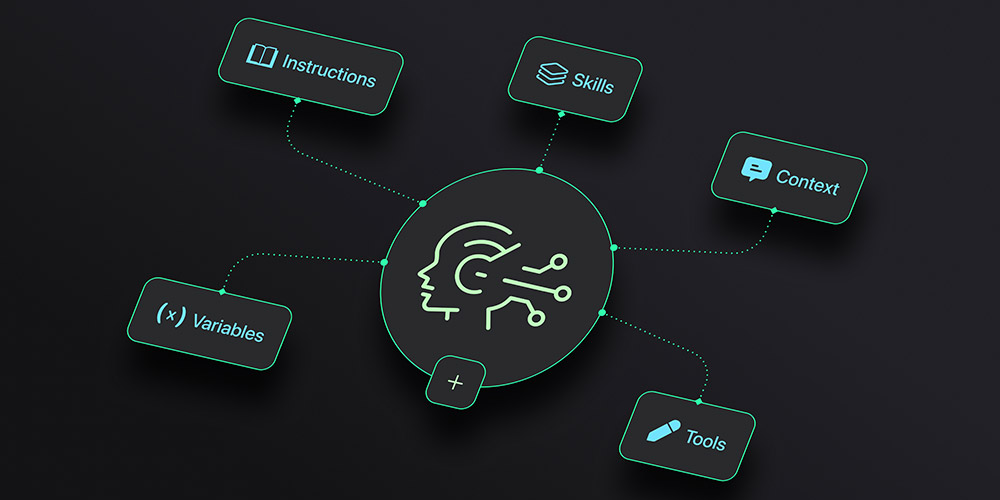
In practice, context engineering means doing the unglamorous work that actually makes AI commercially viable:
- retrieving the right documents, records and prior interactions at the right time
- excluding irrelevant or stale information so the model is not distracted or misled
- controlling tool access and permissions so the system can act without creating unnecessary risk
- preserving workflow state so behaviour stays consistent across steps, handoffs and follow-ups
- deciding when the model should answer, ask for clarification, escalate or stop
- shaping outputs for the downstream business task rather than for a nice-looking demo
That work is less fashionable than prompt folklore, but it is much closer to what buyers actually end up paying for.
"Being agile, iterating, working lean – these aren't suddenly bad approaches. The important change is that these cycles are much, much quicker, more reactive and usually involve smaller, more informed teams, and with that it means the impact of bad strategic and low context is felt much quicker.
Darryl Haydn Jones, CTO, Bonbon Group
Why ROI stays elusive even when adoption rises
Deloitte’s 2025 research surveyed 1,854 senior executives in organisations that already have AI in daily use. The striking thing is not adoption alone. It is that ROI is still elusive even after the spend has started. That usually points to an operating-model problem, not a prompt problem.
If the model is disconnected from source-of-truth systems, if no one has defined acceptable error, if the handoff to humans is vague, or if retrieval quality is weak, the organisation gets novelty instead of leverage.
The prompt can be excellent and the economics can still be poor.
The better question for a business to ask
The commercial question is not “can we use AI?” It is “where does better context create enough trust, speed or throughput to change the economics of the workflow?”
That framing leads to better decisions: where AI should assist, where it should automate, where determinism is safer than flexibility, and where a human should stay in the loop. It also makes the spend easier to justify because you are tying the system to labour cost, response time, conversion, service quality or operational capacity rather than to abstract AI ambition.
Prompting still matters. But it is no longer the main event. Context engineering is where the serious commercial advantage lives now.
Get In Touch
If you are trying to make AI useful in a real product or workflow and want a commercially grounded view of the trade-offs, please get in touch.
Related Articles

What makes a useful AI agent system? Lessons from using OpenClaw